
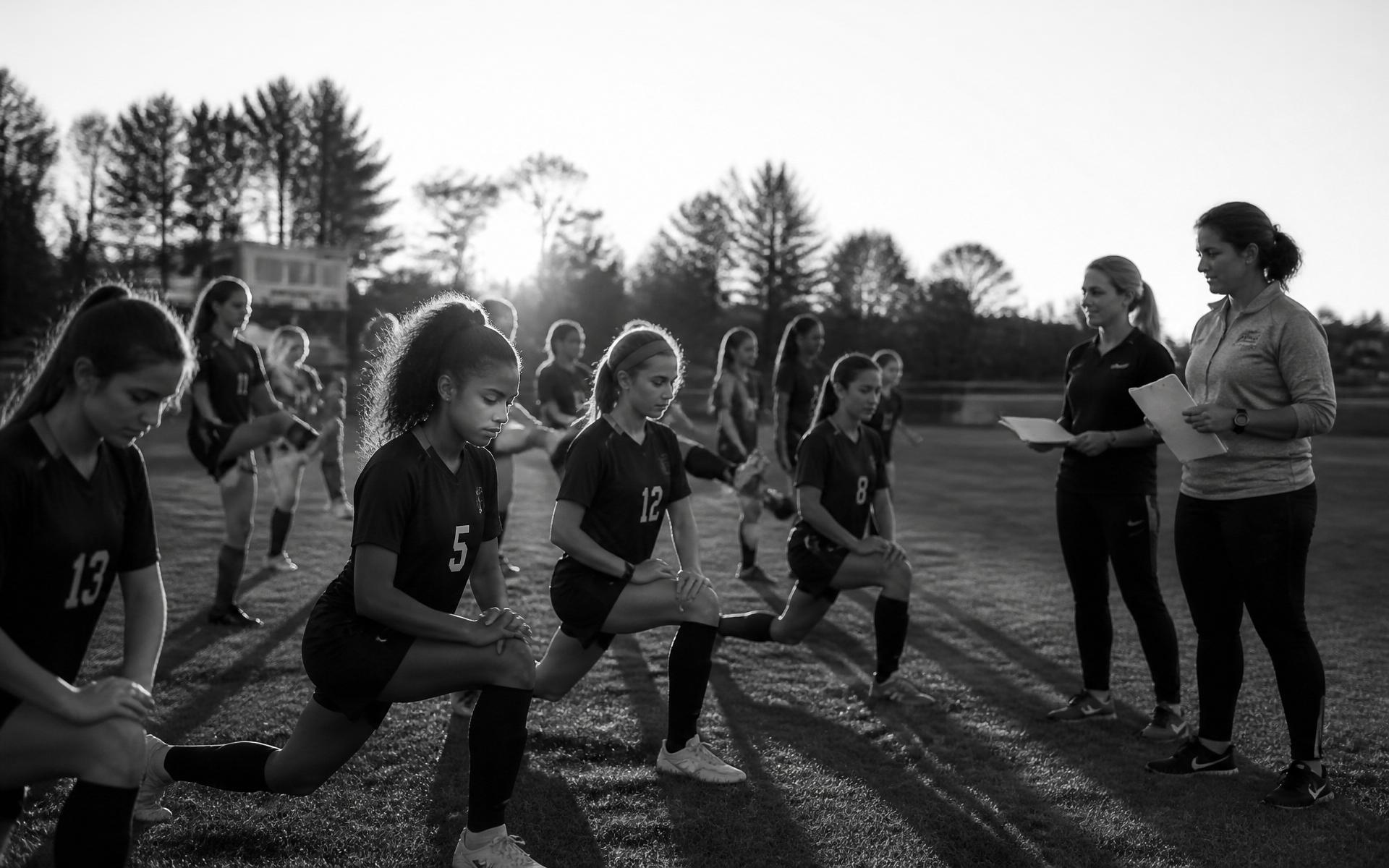
ACL injury prevention exercises for girls’ soccer
Fifteen minutes, two to three times a week, replacing the warm-up your team already runs. Here is the full six-block sequence, the coaching cues that make it work, the season schedule, and the printable cards to take to the field.
The most preventable injury in girls' sport
Non-contact ACL tears are a mechanics problem — and mechanics can be trained.
Most ACL tears in girls’ soccer happen without contact: a hard deceleration, a cut, or a single-leg landing where the knee collapses inward while the foot stays planted. That moment is the product of how an athlete has been trained to move.
Neuromuscular warm-up programs — the family of protocols that includes FIFA 11+ and PEP — retrain exactly those movements. Trials across youth and collegiate soccer have reported large reductions in ACL injury rates for teams that run them consistently, with the biggest effects in adolescent female athletes.
The catch is consistency. The programs that fail are not the wrong drills; they are the right drills run for three weeks in August and then quietly dropped.
The numbers
- 2–8×
Higher ACL injury rate in female athletes than male athletes in the same cutting and pivoting sports.
- ~50%
Reduction in ACL injuries reported in trials of neuromuscular warm-up programs run consistently.
- 15 min
Total session time — it replaces the existing warm-up rather than adding to practice.
- 2–3×/wk
Minimum frequency for the protective effect; teams that drop below this see the benefit fade.
ACL prevention exercises: six blocks, fifteen minutes
Run in order. Every landing rep gets a cue — that is what changes mechanics.
1. Dynamic running
Straight-ahead jog, hip-out and hip-in openers, shuttle runs, and backward running the length of the field. The point is warm tissue and switched-on hips — not fitness.
- Short, quick ground contacts
- Chest tall, eyes up
- No sprinting yet
2. Posterior chain strength
Nordic hamstring lowers (or partner-assisted eccentrics), single-leg Romanian deadlifts, and glute bridges. Hamstring strength is the single most modifiable protector of the ACL.
- Lower slowly, 3+ seconds
- Hips square, knee tracks the toe
- Quality over reps
3. Balance & single-leg control
Single-leg stance with a partner perturbation, single-leg hops with a 2-second stick, and lateral bounds. Most non-contact ACL tears happen on one leg.
- Land and freeze
- Knee over the second toe
- Soft hip and knee bend
4. Plyometrics & landing mechanics
Squat jumps, tuck jumps, broad jumps, and box drops — every rep scored on the landing, not the height. Knee valgus (knee collapsing inward) is the mechanic you are coaching out.
- Land quiet
- Knees apart, not in
- Absorb through the hips
5. Agility & deceleration
Planned cuts, then reactive cuts on a coach's call, plus sprint-to-stop drills. Athletes tear ACLs decelerating and changing direction, so that is what gets rehearsed.
- Chop the steps before the cut
- Wide base, low hips
- Turn the whole body, not just the knee
6. Sport-specific finish
Header-and-land practice, shielding, and 1v1 pressure at game speed — carrying the landing and cutting mechanics straight into soccer actions.
- Same landing rules apply
- Game speed, game shape
- Finish, then go to the whistle
When to run it
Frequency beats intensity. Two sessions a week, every week, outperforms a heavy preseason block.
Preseason (weeks 1–4)
Run the full 15-minute sequence three times per week. Coach the landings hard here — this is where mechanics change. Add a short technique clinic in week 1 so athletes know what a good rep looks like.
In-season (weeks 5–end)
Replace the standard warm-up before every training session, minimum twice a week, plus a shortened version (blocks 1, 3, and 4) before matches.
Offseason & rehab
Keep the strength and balance blocks twice a week. Athletes returning from injury run the sequence under their clinician's return-to-play plan, not the team schedule.
Six ways programs quietly fail
Almost every failure is about adherence and coaching, not drill selection.
Treating it as an add-on
Programs die when they are extra work. This replaces the warm-up your team already does; it should not extend practice by a single minute.
Skipping the coaching cues
Volume without feedback does not change mechanics. Every landing rep needs a cue: knees apart, land quiet, hips back.
Running it only in preseason
The protective effect tracks with consistency. Teams that stop in week 5 lose most of it by the end of the season.
One coach owning it
When the assistant who learned it leaves, the program leaves too. Train the whole staff and print the cards.
Ignoring the tired athlete
Fatigue and under-fueling degrade landing mechanics fast. A program without attention to load and nutrition is only doing half the job.
No screening for the highest risk
Athletes with a prior ACL injury, a family history, or visible knee valgus on a drop jump need extra individual work, not just the team session.
A note on scope. G-MIP is an education-first initiative, not a medical provider. This page describes a general prevention warm-up for healthy athletes. Any athlete with current knee pain, instability, or a prior ACL injury should be guided by her own clinician before joining the sequence.
Is your warm-up actually protecting knees?
Five questions, answered on your device. The result points you at the block of this program that matters most for your team.
Check your risk
For coaches, parents, and athletes in cutting sports.
1.Does the team run a neuromuscular warm-up (strength, balance, landing) before practice?
2.How often are landing and cutting mechanics coached out loud?
3.Does the athlete play one sport year-round?
4.Has the athlete had a previous knee injury?
5.Do the knees drift inward on jumps, landings, or cuts?
Answer all 5 questions to see your result. Nothing is stored or sent — this check runs entirely on your device.
Frequently asked
What is an ACL prevention program?
An ACL prevention program is a structured neuromuscular warm-up — typically 15 minutes — combining dynamic running, hamstring and hip strength, balance, plyometric landing practice, and agility drills. Run two to three times a week, these programs have been shown in multiple trials to substantially reduce non-contact ACL injuries in youth athletes.
Why do girls tear their ACLs more often than boys?
The gap is driven by a combination of factors: differences in landing and cutting mechanics (more knee valgus), relatively lower hamstring-to-quadriceps strength, hip and pelvis geometry, neuromuscular changes across puberty and the menstrual cycle, and — critically — less access to structured strength and landing training. The last of these is the one a program can change directly.
How long does the warm-up take?
About 15 minutes. It replaces the team's existing warm-up rather than adding to the session, so practice length does not change. A shortened 8-minute match-day version keeps the running, balance, and landing blocks.
What age should teams start?
Landing and balance work is appropriate from roughly age 10 upward, and the highest-value window is ages 12 to 18, when ACL injury rates in girls climb sharply. Younger teams focus on movement quality; older teams add loading and reactive agility.
Does the program need special equipment?
No. Cones, a flat field, and a partner are enough for the full sequence. Boxes and resistance bands are useful additions but are not required.
Can this replace physical therapy after an ACL injury?
No. This is a prevention program for healthy athletes. An athlete recovering from an ACL injury or surgery follows a clinician-led rehabilitation and return-to-play plan; the team warm-up is layered back in only when her clinician clears it.
Warm-up cards and coaching tools
Printable sequences, progression charts, and research from the Knowledge Library.
Every claim, sourced
8 peer-reviewed sources. Each links to its PubMed record so you can read the original.
- 1
Hewett TE, Myer GD, Ford KR, et al. Biomechanical measures of neuromuscular control and valgus loading of the knee predict anterior cruciate ligament injury risk in female athletes: a prospective study. Am J Sports Med. 2005;33(4):492-501.
PubMed 15722287 - 2
Mandelbaum BR, Silvers HJ, Watanabe DS, et al. Effectiveness of a neuromuscular and proprioceptive training program in preventing anterior cruciate ligament injuries in female athletes: 2-year follow-up. Am J Sports Med. 2005;33(7):1003-1010.
PubMed 15888716 - 3
Sugimoto D, Myer GD, Foss KDB, Hewett TE. Dosage effects of neuromuscular training intervention to reduce anterior cruciate ligament injuries in female athletes: meta- and sub-group analyses. Sports Med. 2014;44(4):551-562.
PubMed 24370992 - 4
LaBella CR, Huxford MR, Grissom J, Kim KY, Peng J, Christoffel KK. Effect of neuromuscular warm-up on injuries in female soccer and basketball athletes in urban public high schools. Arch Pediatr Adolesc Med. 2011;165(11):1033-1040.
PubMed 22065184 - 5
Soligard T, Myklebust G, Steffen K, et al. Comprehensive warm-up programme to prevent injuries in young female footballers: cluster randomised controlled trial. BMJ. 2008;337:a2469.
PubMed 19066253 - 6
Emery CA, Roy TO, Whittaker JL, Nettel-Aguirre A, van Mechelen W. Neuromuscular training injury prevention strategies in youth sport: a systematic review and meta-analysis. Br J Sports Med. 2015;49(13):865-870.
PubMed 26084526 - 7
Martin D, Timmins K, Cowie C, et al. Injury incidence across the menstrual cycle in international footballers. Front Sports Act Living. 2021;3:616999.
PubMed 33733235 - 8
Lauersen JB, Bertelsen DM, Andersen LB. The effectiveness of exercise interventions to prevent sports injuries: a systematic review and meta-analysis of randomised controlled trials. Br J Sports Med. 2014;48(11):871-877.
PubMed 24100287