
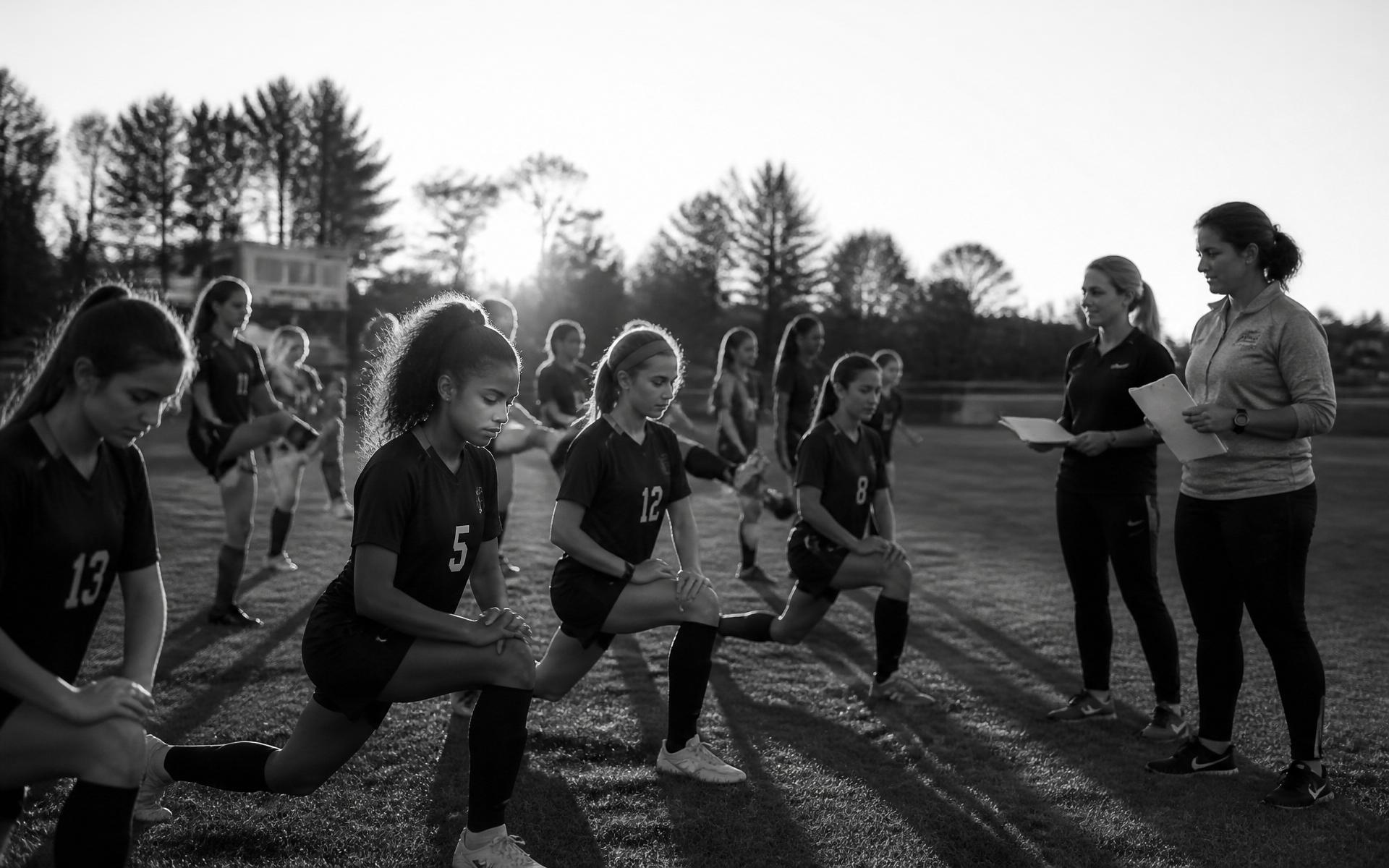
Soccer warm up drills that reduce injury risk
14 drills across six blocks, fifteen minutes total, with reps, coaching cues, and the common error for each one. Print it, take it to the field, run it two to three times a week.
How long?
15 minutes
Full sequence, six blocks. It replaces the warm-up your team already runs, so practice does not get longer. Match day uses an 8-minute version: running, balance, and landing blocks only.
How often?
2–3× per week
Every week of the season, not just preseason. Trials show the protective effect tracks with adherence — teams that stop after preseason lose most of it.
How soon does it work?
4–6 weeks
Landing and cutting mechanics start changing inside a month of consistent work; the injury-rate benefit accumulates across the full season.
Fifteen minutes, timed for you
Press start and coach — the timer walks the team through every drill and beeps at each change. Team mode turns the phone into a sideline scoreboard.
- 1Warm up
- 2Strength
- 3Balance
- 4Landing
- 5Cutting
- 6Ball work
Run this warm-up live
Straight-ahead jog with hip openers
2 lengths
Block 1 — Dynamic running — Tall chest, short quick ground contacts.
Up next: Lateral shuffle and carioca
Build a practice plan you can print
Pick the blocks you want, tune the minutes against a 20-minute target, then print it for the sideline.
Build your practice plan
Pick the blocks you want, adjust the minutes, then print the plan for the sideline.
Temperature
Strength
Balance
Landing
Change of direction
Soccer actions
Your session
Nothing picked yet. Choose blocks on the left; drag or use the arrows to reorder, with a running total against your 20-minute target.
One warm-up, run the same way every week
The drills matter less than the consistency and the cueing.
This is the drill-by-drill version of the neuromuscular warm-up G-MIP teaches. Run the blocks in order: temperature first, then strength, then balance, then landing, then change of direction, then soccer actions at game speed.
Cue every landing rep. Volume without feedback does not change how an athlete moves. Knees apart, land quiet, hips back — said out loud, every rep, by whoever is running the block.
Keep the whole sequence inside fifteen minutes so it replaces the existing warm-up instead of extending practice. If time is short, cut reps, not blocks.
Quick reference
- Block 1 — Dynamic running3 min
- Block 2 — Posterior chain strength3 min
- Block 3 — Balance and single-leg control2 min
- Block 4 — Plyometrics and landing mechanics3 min
- Block 5 — Agility and deceleration2 min
- Block 6 — Sport-specific finish2 min
Related resources
Browse warm-up resources14 drills, six blocks, fifteen minutes
Each drill lists the dose, how to run it, the cue to say out loud, and the mistake that cancels the benefit.
Block 1 — Dynamic running
3 minRaise tissue temperature and switch the hips on. Everything runs between two cones roughly 20 yards apart.
Straight-ahead jog with hip openers
2 lengthsJog out at conversational pace. Every fourth stride, open one hip out to the side and step through; alternate legs.
Cue: Tall chest, short quick ground contacts.
Common error: Racing the length. This is a temperature drill, not conditioning.
Lateral shuffle and carioca
1 length each wayShuffle facing the sideline out, carioca (hip-over-hip crossover) back, then switch lead side.
Cue: Hips low, feet never click together.
Common error: Standing upright, which turns the shuffle into a skip.
Backward running
2 lengthsRun backward with a slight forward lean, reaching behind with the toe and pulling the ground back.
Cue: Stay on the balls of the feet, eyes over the shoulder.
Common error: Sitting back on the heels and losing the hamstring load.
Block 2 — Posterior chain strength
3 minHamstring and glute strength is the most modifiable protector of the knee. Slow reps only.
Nordic hamstring lower
3–5 repsKneel with a partner pinning the ankles. Lower the torso toward the ground as slowly as possible, catch with the hands, push back up.
Cue: Fight the fall for at least three seconds.
Common error: Bending at the hips so the body folds instead of the hamstrings braking.
Single-leg Romanian deadlift
6 per legStand on one leg, hinge at the hip with a flat back until the torso is parallel to the ground, free leg extending behind.
Cue: Hips stay square — imagine headlights pointing at the ground.
Common error: Rotating the pelvis open, which removes the load from the standing glute.
Block 3 — Balance and single-leg control
2 minMost non-contact injuries happen on one leg. Train the leg that will actually be loaded.
Partner perturbation stance
20 sec per legBalance on one leg, knee softly bent. A partner taps the shoulders and hips at random from different angles.
Cue: Correct at the hip, not by waving the arms.
Common error: Locking the standing knee straight.
Single-leg hop and stick
5 per legHop forward on one leg and freeze the landing for two full seconds before the next rep.
Cue: Land and freeze — knee over the second toe.
Common error: Chaining hops together so no landing is ever controlled.
Block 4 — Plyometrics and landing mechanics
3 minEvery rep is scored on the landing, never the height. This is where knee valgus gets coached out.
Squat jump to soft landing
8 repsJump vertically from a quarter squat and absorb the landing back into the same squat depth.
Cue: Land quiet — the sound is the score.
Common error: Landing stiff-legged with a loud slap.
Broad jump with stick
6 repsJump forward for distance, land on two feet and hold for two seconds before resetting.
Cue: Knees apart, hips back, absorb through the hips.
Common error: Hopping straight into the next jump before the landing settles.
Lateral bound
6 per sidePush sideways off one leg, land on the outside leg, stick, then bound back.
Cue: Land on the whole foot, hip loaded under you.
Common error: Letting the landing knee dive inward toward the midline.
Block 5 — Agility and deceleration
2 minAthletes get hurt slowing down and changing direction, so that is what gets rehearsed.
Planned 45-degree cut
4 per sideRun five yards, plant on the outside foot and cut 45 degrees through a cone gate.
Cue: Chop the steps before the plant, drop the hips.
Common error: Cutting at full stride length with a straight leg.
Reactive cut on the coach's call
4 repsSame approach run, but the coach points left or right only once the athlete is two strides out.
Cue: Turn the whole body, not just the knee.
Common error: Introducing this before planned cuts look clean.
Block 6 — Sport-specific finish
2 minCarry the landing and cutting rules straight into soccer actions at game speed.
Header and land
6 repsPartner serves; the athlete jumps, heads, and lands on two feet under control.
Cue: Same landing rules apply in the air as on the ground.
Common error: Landing on one leg with a twisted trunk.
1v1 shielding to turn
4 per sideReceive under light pressure, shield, then turn out and accelerate three yards.
Cue: Wide base on the turn, low hips.
Common error: Running it at walking pace, which trains nothing the game will ask for.
A note on scope. G-MIP is an education-first initiative, not a medical provider. These are general warm-up drills for healthy athletes. Any athlete with current pain, swelling, instability, or a recent injury should be guided by her own clinician before joining the sequence.
Frequently asked
How long should a soccer warm-up be?
About 15 minutes. This sequence replaces the warm-up a team already runs rather than adding to the session, so practice length does not change. On match days, run a shortened version: dynamic running, balance, and landing.
What order should warm-up drills go in?
Dynamic running first to raise temperature, then strength, balance, plyometrics, agility, and a sport-specific finish. Landing and cutting work belongs after the body is warm and before fatigue sets in — not at the end of practice.
How often does the team need to run it?
Two to three times a week, every week. The benefit tracks with consistency; teams that run it in preseason and then drop it lose most of the effect by mid-season.
Do these drills need equipment?
No. Cones, a flat surface, a ball, and a partner cover the whole sequence. Boxes and bands are useful additions but are never required.
What age can teams start these drills?
Landing and balance work suits athletes from roughly age 10 upward. Younger teams focus on movement quality and lower rep counts; older teams add loading and reactive agility.
Warm-up cards and coaching tools
Printable sequences and progression charts from the Knowledge Library.
Every claim, sourced
7 peer-reviewed sources. Each links to its PubMed record so you can read the original.
- 1
Soligard T, Myklebust G, Steffen K, et al. Comprehensive warm-up programme to prevent injuries in young female footballers: cluster randomised controlled trial. BMJ. 2008;337:a2469.
PubMed 19066253 - 2
Mandelbaum BR, Silvers HJ, Watanabe DS, et al. Effectiveness of a neuromuscular and proprioceptive training program in preventing anterior cruciate ligament injuries in female athletes: 2-year follow-up. Am J Sports Med. 2005;33(7):1003-1010.
PubMed 15888716 - 3
LaBella CR, Huxford MR, Grissom J, Kim KY, Peng J, Christoffel KK. Effect of neuromuscular warm-up on injuries in female soccer and basketball athletes in urban public high schools. Arch Pediatr Adolesc Med. 2011;165(11):1033-1040.
PubMed 22065184 - 4
Dick R, Putukian M, Agel J, Evans TA, Marshall SW. Descriptive epidemiology of collegiate women's soccer injuries: NCAA Injury Surveillance System, 1988-1989 through 2002-2003. J Athl Train. 2007;42(2):278-285.
PubMed 17710177 - 5
Emery CA, Roy TO, Whittaker JL, Nettel-Aguirre A, van Mechelen W. Neuromuscular training injury prevention strategies in youth sport: a systematic review and meta-analysis. Br J Sports Med. 2015;49(13):865-870.
PubMed 26084526 - 6
Lauersen JB, Bertelsen DM, Andersen LB. The effectiveness of exercise interventions to prevent sports injuries: a systematic review and meta-analysis of randomised controlled trials. Br J Sports Med. 2014;48(11):871-877.
PubMed 24100287 - 7
Hewett TE, Myer GD, Ford KR, et al. Biomechanical measures of neuromuscular control and valgus loading of the knee predict anterior cruciate ligament injury risk in female athletes: a prospective study. Am J Sports Med. 2005;33(4):492-501.
PubMed 15722287