
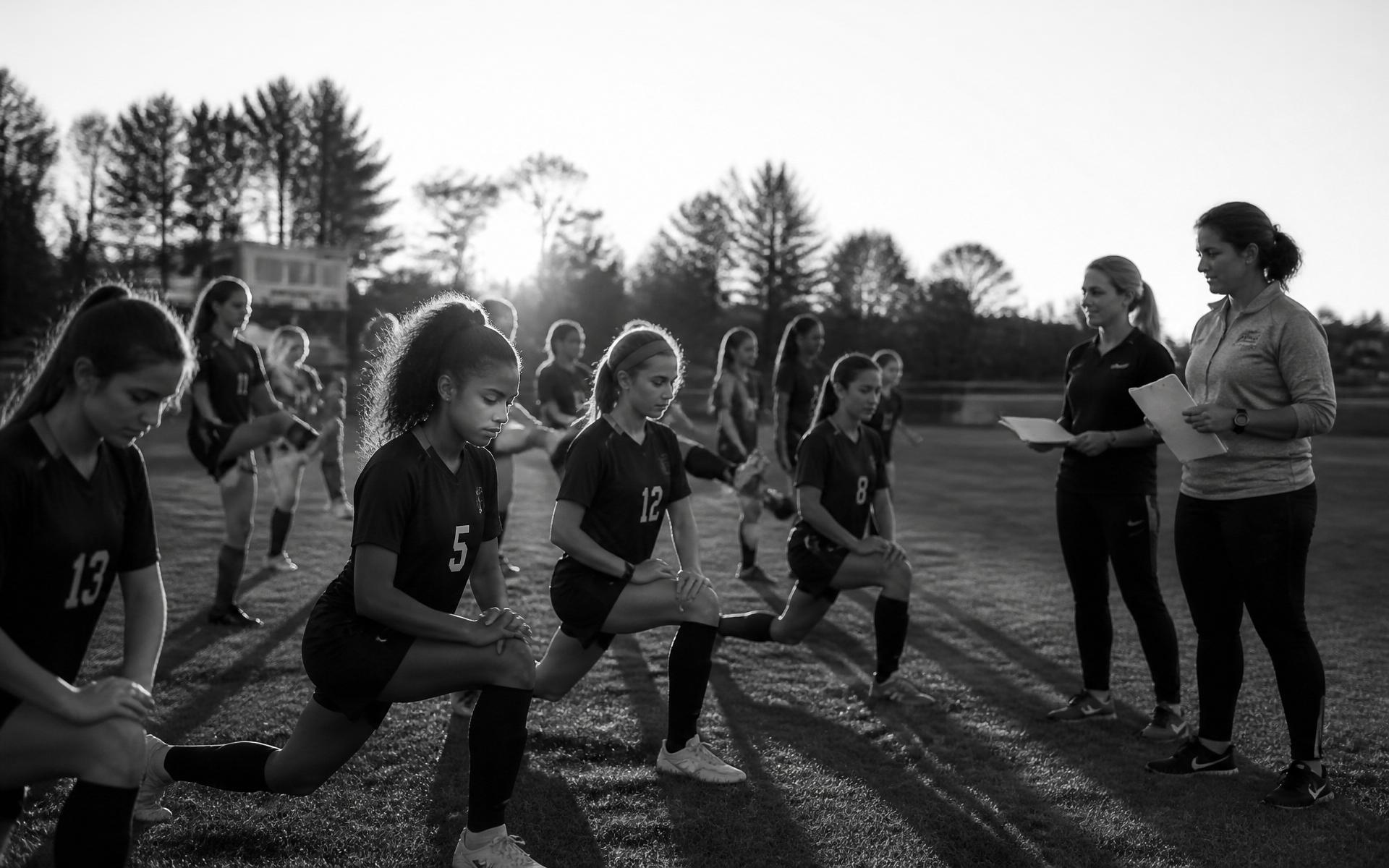
How to prevent sports injuries in girls.
Girls get injured differently — and prevention that ignores that gap fails them. This is the whole G-MIP system in one place: the research, the programs, the printable tools, and a step-by-step path whether you run a school athletic program or you are a parent on the sideline.
How do you prevent sports injuries?
Most injuries in girls’ sport are trainable. Replace the warm-up with a 15-minute neuromuscular sequence two to three times a week. Build hip and hamstring strength so the knee does not collapse inward on landing. Keep fueling and load in balance, and treat pain or swelling as a reason to be evaluated, not to push through.
Find your guide
Five stops, in order
Work through the Core Guides one at a time. Your progress is ticked off on this device only.
Your learning path
Five stops, in order. Tick each one off — progress is saved on this device only.
Start here
Understand what is actually preventable
The short version of why girls get hurt at different rates — and which of those injuries training can change.
Open the guideStep 2
Put the 15-minute warm-up in place
The neuromuscular sequence that lowers ACL risk, run two to three times a week in place of the old warm-up.
Open the guideStep 3
Build the strength underneath it
Hip, hamstring, and trunk strength so the knee has something holding it in line on every landing.
Open the guideStep 4
Keep fueling and load in balance
Energy, periods, and bone health — the part of injury prevention that happens off the field.
Open the guideStep 5
Know what to do when something hurts
Triage the common injuries, spot the red flags, and know when an athlete needs to be seen.
Open the guide
Today's readiness check
Ease up
Train, but lighter. Prioritize warm-up, food and sleep tonight.
Saved on this device only. Not a medical assessment.
Two paths in
Prevention stalls when people cannot tell which of twenty pages to read first. Pick the track that matches your role and work down the list.
For schools & coaches
You have a season starting and limited practice time. Here is the shortest path from zero to a running program.
Tap a number to check off a step
Read the risk brief
Ten minutes on why your female athletes need a different warm-up than your male athletes.
The ProblemStart the ACL warm-up
The 15-minute neuromuscular sequence that replaces your current warm-up, block by block with coaching cues.
ACL prevention programPrint the drill sheet
Every drill with reps, coaching cues, and the common error — one page you can take to the field.
Soccer warm-up drillsDownload the coach kit
Warm-up cards, session checklists, and progression charts you can print and take to the field.
Knowledge LibraryFormalize the partnership
Make prevention a standing policy, not one coach's side project.
Partner with us
Your progress
0/7
Up next: Read the risk brief
For parents & families
You want to know what your daughter's program should be doing — and what to do when something hurts.
Tap a number to check off a step
Learn the warning signs
What joint pain, missed periods, and mid-season fatigue actually signal.
Female athlete triad & RED-S guideCheck her team's warm-up
What an ACL prevention warm-up should look like — so you know whether her program is running one.
ACL prevention programRead the parent guides
Plain-language guides on nutrition, recovery, growth-plate injuries, and return-to-play.
Parent resourcesAsk your program the right questions
The Playbook includes a checklist of what to ask a coach or athletic director before the season starts.
Open the Playbook
Your progress
0/5
Up next: Learn the warning signs
The prevention system
Every core guide in one grid — read them in any order once you know where you are going.

The Female Athlete Safety Playbook
Our flagship field manual: movement screening, the 12-minute neuromuscular warm-up, load management, concussion protocols, fueling and bone health, and criteria-based return to play — written for coaches, athletes, parents, clinicians, and schools.
- 6 sections, dozens of practice-ready subsections
- Coach and player checklists on every page
- Screening, warm-up, and return-to-play protocols
- Season-long rollout and policy templates
PDF · Free for coaches, parents, athletes, clinicians, and schools
What schools and parents ask first
Short answers to the questions that come up in every intake call.
Why do girls get injured differently than boys?
Adolescent female athletes tear their ACL at several times the rate of boys in the same sports. The drivers are a mix of neuromuscular control, landing and cutting mechanics, hormonal cycling, and training loads designed around male athletes. Prevention has to be female-specific to work.
What actually prevents these injuries?
Structured neuromuscular training — a consistent warm-up combining plyometrics, strength, balance, and landing technique — is the most evidence-backed intervention. The catch is consistency: programs run 2 to 3 times per week across a full season deliver the reductions research reports.
How long does a prevention warm-up take?
Roughly 15 to 20 minutes, replacing a traditional warm-up rather than adding to practice. Coaches who treat it as a bolt-on extra abandon it by mid-season; coaches who treat it as the warm-up keep it.
Who should lead the program at a school?
An athletic director or head coach owns adoption, but peer leaders run it day to day. Athlete-led warm-ups sustain far better than ones that depend on a single adult being present.
What should parents watch for?
Persistent joint pain, a limp that lasts more than a few days, missed periods, unusual fatigue, and a drop in appetite or performance. These are signals for a sports medicine evaluation, not something to train through.
Bring prevention to your season.
Tell us about your program and we will map the fastest route to a running warm-up — whether you have one team or a whole district.
Every claim, sourced
8 peer-reviewed sources. Each links to its PubMed record so you can read the original.
- 1
Lauersen JB, Bertelsen DM, Andersen LB. The effectiveness of exercise interventions to prevent sports injuries: a systematic review and meta-analysis of randomised controlled trials. Br J Sports Med. 2014;48(11):871-877.
PubMed 24100287 - 2
Emery CA, Roy TO, Whittaker JL, Nettel-Aguirre A, van Mechelen W. Neuromuscular training injury prevention strategies in youth sport: a systematic review and meta-analysis. Br J Sports Med. 2015;49(13):865-870.
PubMed 26084526 - 3
Soligard T, Myklebust G, Steffen K, et al. Comprehensive warm-up programme to prevent injuries in young female footballers: cluster randomised controlled trial. BMJ. 2008;337:a2469.
PubMed 19066253 - 4
Sugimoto D, Myer GD, Foss KDB, Hewett TE. Dosage effects of neuromuscular training intervention to reduce anterior cruciate ligament injuries in female athletes: meta- and sub-group analyses. Sports Med. 2014;44(4):551-562.
PubMed 24370992 - 5
Gabbett TJ. The training—injury prevention paradox: should athletes be training smarter and harder? Br J Sports Med. 2016;50(5):273-280.
PubMed 26758673 - 6
Jayanthi N, Pinkham C, Dugas L, Patrick B, LaBella C. Sports specialization in young athletes: evidence-based recommendations. Sports Health. 2013;5(3):251-257.
PubMed 24427397 - 7
Bahr R. Why screening tests to predict injury do not work — and probably never will: a critical review. Br J Sports Med. 2016;50(13):776-780.
PubMed 27095747 - 8
Mountjoy M, Ackerman KE, Bailey DM, et al. 2023 International Olympic Committee's (IOC) consensus statement on Relative Energy Deficiency in Sport (REDs). Br J Sports Med. 2023;57(17):1073-1097.
PubMed 37752011