
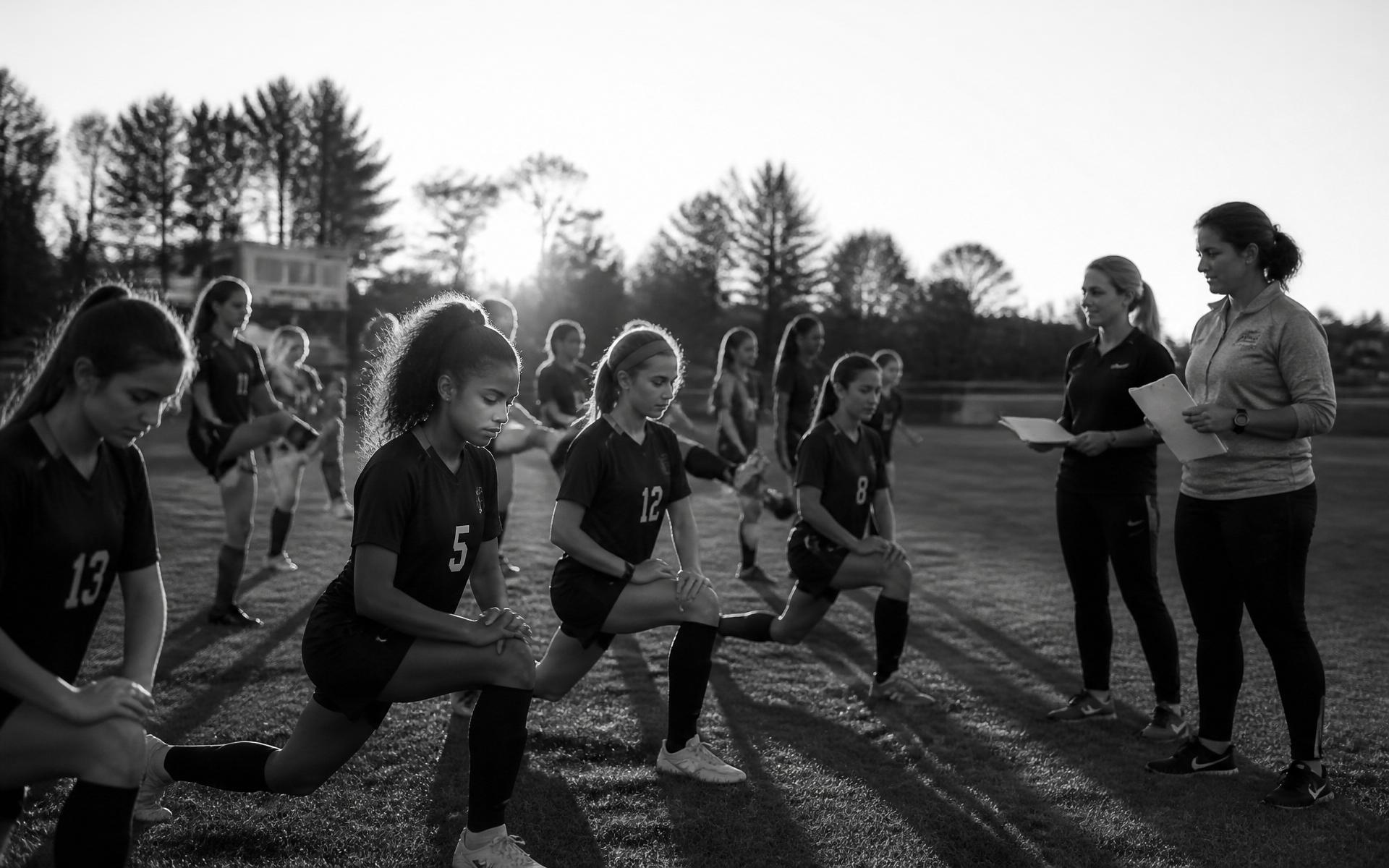
How to prevent knee injuries in young athletes.
Most knee injuries in girls’ sports are non-contact, which means they are trainable. Here are the injuries worth knowing, the exercises that lower risk, and the weekly routine that makes it stick.
The four knee injuries that end seasons
Different mechanisms, one shared root: how the knee is loaded when the athlete lands, cuts, and decelerates.
ACL tears
Usually non-contact: a hard deceleration or single-leg landing where the knee collapses inward. Adolescent girls tear the ACL several times more often than boys in the same sports.
Patellofemoral pain
Aching at the front of the knee, worst on stairs and after sitting. Driven by hip and quad control, training-load spikes, and shoes or surfaces that changed suddenly.
Meniscus injuries
Twisting on a planted foot, often alongside an ACL injury. Locking, catching, or swelling that returns after every session needs a clinician, not more training.
Patellar tendinopathy
Jumper's knee. A load problem more than a technique problem: it shows up when jump volume climbs faster than tissue can adapt.
Six knee injury prevention exercises
Strength for the tissue, landing practice for the mechanics, reaction work for the game.
Nordic hamstring lowers
3 × 5, twice weeklyHamstring strength is the most modifiable protector of the ACL — it resists the forward shear the ligament otherwise absorbs.
Single-leg Romanian deadlift
3 × 8 each legTrains hip hinge and balance on one leg, which is how nearly every knee injury actually happens.
Glute bridges & side-lying abduction
3 × 12Weak hip abductors let the knee drift inward under load — the mechanic behind both ACL tears and kneecap pain.
Squat, tuck, and broad jumps
3 × 6, scored on landingsLanding practice with feedback is what changes mechanics. Knees apart, land quiet, absorb through the hips.
Single-leg hop and stick
3 × 5 each legBuilds the deceleration control that cutting and stopping demand.
Reactive cutting drills
2 min at game speedPlanned cuts are safer than unplanned ones — rehearsing reaction closes the gap between practice and match.
What a protected week looks like
Frequency beats intensity. Two to three sessions a week, every week of the season.
Every training session
Replace the standard warm-up with the 15-minute neuromuscular sequence: running, strength, balance, landings, agility.
Twice weekly
Add the posterior-chain and hip strength block — Nordics, single-leg RDLs, glute work — after practice while athletes are warm.
Match day
Shortened 8-minute version: dynamic running, balance, and landing blocks only.
Weekly check
Watch one drop-jump per athlete. Knees tracking inward is the flag to coach hard the next week.
How protected are her knees right now?
Five questions, answered on your device. The result tells you which part of this guide to start with.
Check your risk
1.Does she do strength work (squats, hinges, single-leg) at least twice a week?
2.Do her knees stay in line over the toes on landings?
3.Any current ache around the kneecap or below it after jumping or stairs?
4.How many hours a week does she train in her main sport?
5.Has she had a previous knee injury?
Answer all 5 questions to see your result. Nothing is stored or sent — this check runs entirely on your device.
Frequently asked
How do you prevent knee injuries in sports?
The evidence points to one thing above all: a structured neuromuscular warm-up run two to three times a week, all season. It combines hamstring and hip strength, single-leg balance, plyometric landing practice, and agility drills. Programs of this type have reported roughly 50% reductions in ACL injuries when teams stay consistent.
What exercises prevent knee injuries?
Nordic hamstring lowers, single-leg Romanian deadlifts, glute bridges and hip abduction work, squat and tuck jumps coached on the landing, single-leg hop-and-stick, and reactive cutting drills. Volume matters less than feedback — each landing rep needs a cue.
Why are girls more likely to injure their knees?
Landing and cutting mechanics with more knee valgus, a lower hamstring-to-quadriceps strength ratio, hip and pelvis geometry, neuromuscular change across puberty, and less access to structured strength training. The last of these is the one a program can fix directly.
How long before it works?
Mechanics start changing within four to six weeks of consistent work, and the injury-rate benefit tracks with adherence across the whole season. Teams that stop after preseason lose most of it.
Do knee braces prevent injuries?
Bracing has a role after an injury, under a clinician's direction. For healthy athletes there is no good evidence a brace substitutes for strength and landing training.
A note on scope. G-MIP is an education-first initiative, not a medical provider. This page covers prevention for healthy athletes. Any athlete with current knee pain, swelling, or instability should be evaluated by her own clinician first.
Knee risk looks different in every sport
The same strength and landing work, applied to the actions each sport actually demands.
Where to go next
Every claim, sourced
8 peer-reviewed sources. Each links to its PubMed record so you can read the original.
- 1
Hewett TE, Myer GD, Ford KR, et al. Biomechanical measures of neuromuscular control and valgus loading of the knee predict anterior cruciate ligament injury risk in female athletes: a prospective study. Am J Sports Med. 2005;33(4):492-501.
PubMed 15722287 - 2
van der Worp H, van Ark M, Roerink S, Pepping GJ, van den Akker-Scheek I, Zwerver J. Risk factors for patellar tendinopathy: a systematic review of the literature. Br J Sports Med. 2011;45(5):446-452.
PubMed 21367808 - 3
Sugimoto D, Myer GD, Foss KDB, Hewett TE. Dosage effects of neuromuscular training intervention to reduce anterior cruciate ligament injuries in female athletes: meta- and sub-group analyses. Sports Med. 2014;44(4):551-562.
PubMed 24370992 - 4
Emery CA, Roy TO, Whittaker JL, Nettel-Aguirre A, van Mechelen W. Neuromuscular training injury prevention strategies in youth sport: a systematic review and meta-analysis. Br J Sports Med. 2015;49(13):865-870.
PubMed 26084526 - 5
Lauersen JB, Bertelsen DM, Andersen LB. The effectiveness of exercise interventions to prevent sports injuries: a systematic review and meta-analysis of randomised controlled trials. Br J Sports Med. 2014;48(11):871-877.
PubMed 24100287 - 6
Gabbett TJ. The training—injury prevention paradox: should athletes be training smarter and harder? Br J Sports Med. 2016;50(5):273-280.
PubMed 26758673 - 7
Jayanthi N, Pinkham C, Dugas L, Patrick B, LaBella C. Sports specialization in young athletes: evidence-based recommendations. Sports Health. 2013;5(3):251-257.
PubMed 24427397 - 8
Martin D, Timmins K, Cowie C, et al. Injury incidence across the menstrual cycle in international footballers. Front Sports Act Living. 2021;3:616999.
PubMed 33733235