
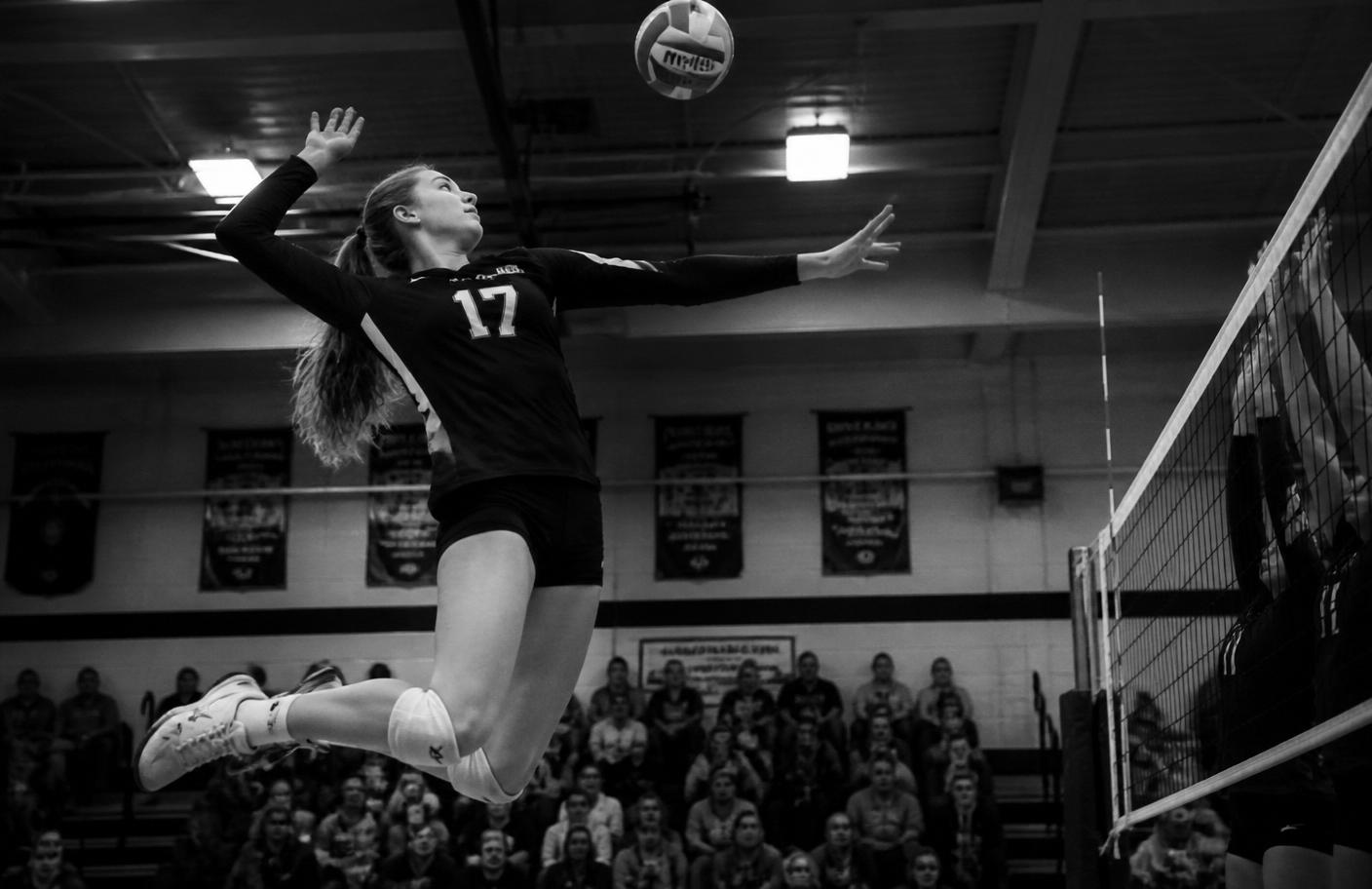
Jumper’s knee exercises.
Patellar tendinopathy is the most common overuse knee injury in jumping sports — and the most mismanaged. Rest alone does not fix it. Progressive loading does. Here is the routine, stage by stage.
Female Evidence Standard
Our citation rule: studies must include verified female participants. Male-only studies are excluded.
Read our evidence-selection policyWhy the tendon breaks down
Jumper's knee is a load problem, not a bad-luck problem — four forces push it past its limit.
The overloaded tendon
Jumper's knee is not inflammation that needs rest — it is a tendon that has been loaded faster than it could adapt. Total rest feels better short-term and makes the tendon weaker long-term.
The season-long grind
Volleyball and basketball athletes can jump hundreds of times per week. When practices, club play, and school seasons stack, the patellar tendon never gets the recovery window it needs.
Landing mechanics
Stiff, upright landings with the knees caving inward push load straight into the front of the knee. The same mechanics that raise ACL risk also drive jumper's knee.
Playing through it
Early jumper's knee warms up and fades during play, which makes it easy to ignore. Athletes who keep full training through pain for months are the ones who end up with the hard-to-treat version.
Six jumper's knee exercises, in order
Start where her pain allows and progress by the 24-hour rule — not by the calendar.
Isometric leg extension hold
5 × 45 sec, dailyThe pain-relief entry point. A sustained hold at roughly 60 degrees of knee bend reduces tendon pain enough to keep athletes practicing while the loading program starts.
Spanish squat (isometric)
5 × 45 sec, dailyA strap behind the knees shifts load forward into the quads and tendon. A staple of modern physiotherapy management of patellar tendinopathy.
Slow decline squat
3 × 15, slow lowerLowering slowly on a 25-degree decline board is the classic eccentric training program for jumper's knee. Pain during reps up to about 4/10 is acceptable; pain that worsens the next day is not.
Heavy slow leg press
3 × 8, 3 sec downThe mid-stage progression. Heavy, slow resistance loads the tendon through a full range without the impact of jumping — building capacity the sport will eventually demand.
Single-leg squat to box
3 × 10 each legRestores the hip and knee control that disappears when athletes guard a sore knee. Watch for the knee drifting inward over the toes and correct it.
Jump-and-stick re-entry
3 × 5, soft landingsThe return-to-sport bridge. Low-volume jumping with perfect, quiet landings — knees tracking over toes, hips absorbing the load — before full practice resumes.
What a tendon-safe week looks like
Daily pain relief, three loading days, and one rule that tells you whether the dose was right.
Daily
Isometric holds (leg extension or Spanish squat) for pain relief — 45 seconds, five times, any time of day.
3x weekly
The loading session: slow decline squats plus heavy slow strength work, on non-consecutive days so the tendon recovers between doses.
Every jump session
Audit landing quality, not just quantity. Quiet, bent-knee landings with hips back — and cap total jumps when knee pain is trending up.
The 24-hour rule
Judge the program by morning pain. If the knee is stiffer the day after loading than the day before, reduce the next dose — progressive loading, not rest, is what heals the tendon.
Progress stage by stage
Check off each session as you finish it. Progress is saved on this device only — no account, nothing shared.
Loading tracker
0 of 32 sessions logged — saved on this device only.
Isometric holds: 5 x 30-45 seconds of a heavy, pain-tolerable hold (wall sit, leg extension hold, or single-leg squat hold) once or twice daily.
Move up when
Pain during and after holds sits at or below 3/10 and morning stiffness is easing.
The 24-hour rule
Pain during the session should stay at or below 3/10, and must settle back to its usual level within 24 hours. If it is worse the next morning, repeat the previous session instead of progressing.
Tendon-loading exercise library
Filter by body part and equipment, then open a card for the steps, the coaching cue, and the error that stalls recovery.
Exercise library
Is this jumper's knee — or something else?
Five questions, answered on your device. The pattern below matches what clinicians screen for first.
Check your risk
1.Where is the pain?
2.When does it hurt most?
3.Does it warm up with activity, then return worse the next morning?
4.How long has it been going on?
5.Has total rest made it better long-term?
Answer all 5 questions to see your result. Nothing is stored or sent — this check runs entirely on your device.
Frequently asked
What are the best exercises for jumper's knee?
A staged approach works best: isometric holds for pain relief, then slow decline squats and heavy slow strength work to rebuild tendon capacity, then low-volume jumping with clean landings before full return. Systematic reviews of exercise programs consistently support progressive loading over passive treatments.
Should my daughter rest her jumper's knee completely?
Complete rest relieves pain but does not rebuild the tendon — symptoms usually return when jumping resumes. The evidence-backed approach is modified load: keep training within tolerable pain (about 4/10) while running a progressive strengthening program.
How long does jumper's knee take to heal?
Expect weeks to months, not days. Tendons adapt slowly. Athletes who follow a structured loading program typically see steady improvement over 8 to 12 weeks; the ones who stop and start repeatedly are the cases that drag into a second season.
Is jumper's knee common in girls' sports?
Yes — it clusters wherever jumping volume is high: volleyball, basketball, and track jumps. In collegiate women's volleyball, knee overuse injuries like patellar tendinopathy are among the leading causes of lost practice time.
When should we see a clinician for knee pain?
Pain that stops her from training, pain at rest or at night, swelling, locking, or symptoms that do not improve after four weeks of modified load all warrant a sports medicine evaluation — and younger athletes with front-of-knee pain should be checked for growth-plate causes first.
A note on scope. G-MIP is an education-first initiative, not a medical provider. This page covers prevention and general rehabilitation principles. An athlete with knee pain that stops training, swelling, or symptoms in a growing athlete should be evaluated by her own clinician.
Jumping load looks different in every sport
The same loading principles, applied to where each sport actually piles up jumps.
Where to go next
Every claim, sourced
6 peer-reviewed sources. Each links to its PubMed record so you can read the original.
- 1
Visnes H, Bahr R. The evolution of eccentric training as treatment for patellar tendinopathy (jumper's knee): a critical review of exercise programmes. Br J Sports Med. 2007;41(4):217-223.
PubMed 17261559 - 2
Rudavsky A, Cook J. Physiotherapy management of patellar tendinopathy (jumper's knee). J Physiother. 2014;60(3):122-129.
PubMed 25092419 - 3
Cook JL, Khan KM, Harcourt PR, Grant M, Young DA, Bonar SF. A cross sectional study of 100 athletes with jumper's knee managed conservatively and surgically. Br J Sports Med. 1997;31(4):332-336.
PubMed 9429013 - 4
van der Worp H, van Ark M, Roerink S, Pepping GJ, van den Akker-Scheek I, Zwerver J. Risk factors for patellar tendinopathy: a systematic review of the literature. Br J Sports Med. 2011;45(5):446-452.
PubMed 21367808 - 5
Agel J, Palmieri-Smith RM, Dick R, Wojtys EM, Marshall SW. Descriptive epidemiology of collegiate women's volleyball injuries: NCAA Injury Surveillance System, 1988-1989 through 2003-2004. J Athl Train. 2007;42(2):295-302.
PubMed 17710179 - 6
Gabbett TJ. The training—injury prevention paradox: should athletes be training smarter and harder? Br J Sports Med. 2016;50(5):273-280.
PubMed 26758673