
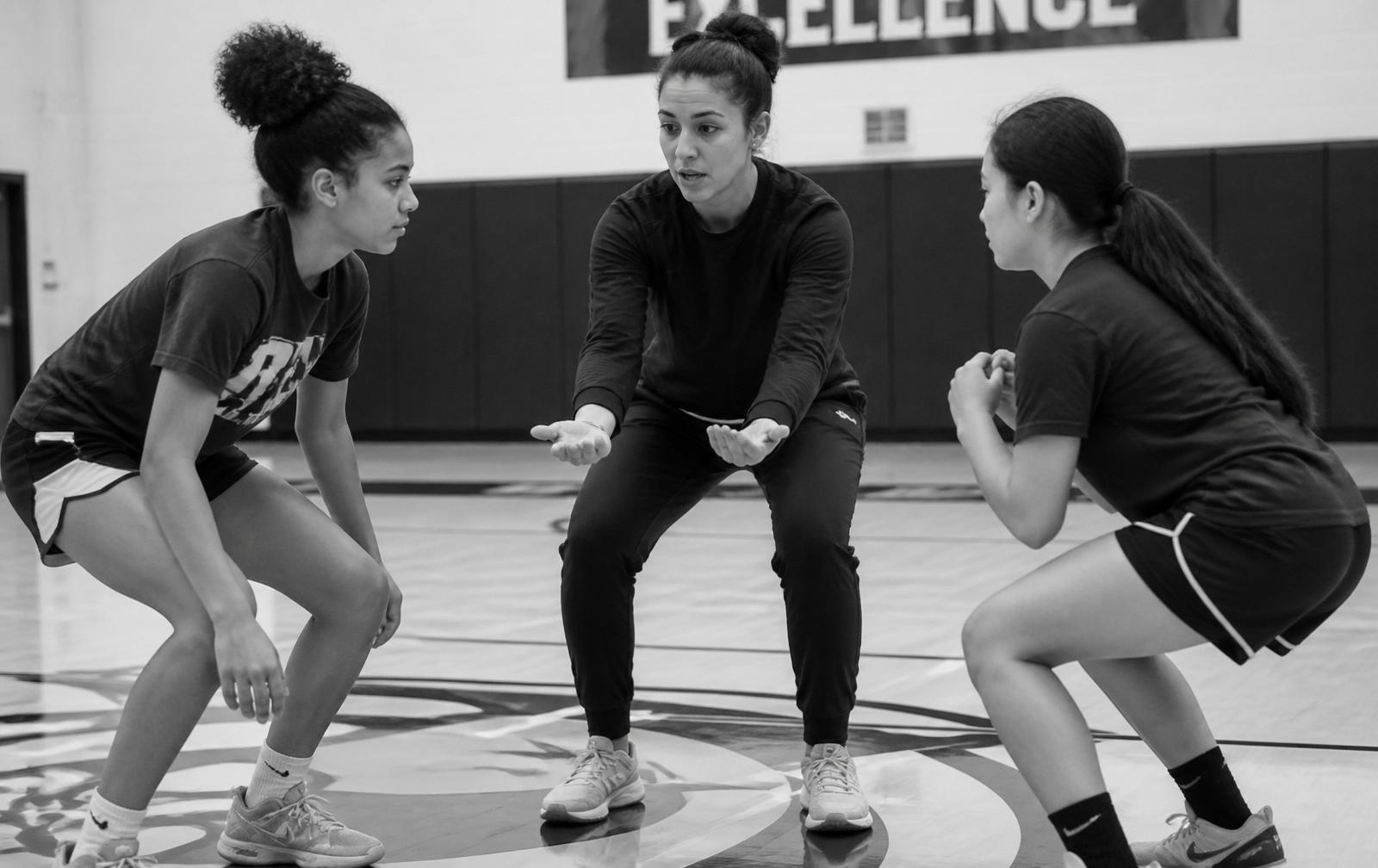
Strength training for teenage girls.
The single most underused injury-prevention tool in girls’ sports. Why it’s safe, why it matters more for girls, and the two-day weekly plan that protects knees, ankles, and growing bones.
Female Evidence Standard
Our citation rule: studies must include verified female participants. Male-only studies are excluded.
Read our evidence-selection policyFour reasons this is non-negotiable
Every major sports medicine body recommends youth strength training. Girls' programs are the least likely to offer it.
It prevents injuries
Strength and neuromuscular training is the most consistently proven injury-prevention tool in youth sport — a meta-analysis found strength training cut sports injuries substantially, more than stretching or any other single intervention.
It closes the strength gap
Girls enter puberty and gain height and mass without a matching gain in strength — the exact window when ACL and kneecap injuries spike. Structured lifting is how the gap closes.
It builds bone for life
The teen years set most of a woman's peak bone density. Loaded, impact-based strength work during adolescence is protection against stress fractures now and osteoporosis decades later.
It changes how athletes see themselves
Girls who lift report higher confidence and body appreciation — they start asking what their body can do instead of how it looks.
Six lifts, twice a week
Dumbbells and bodyweight are enough. Technique and supervision come before load — always.
Goblet squat
3 × 8The foundational pattern. A weight held at the chest teaches depth, bracing, and knee tracking before a barbell ever appears.
Romanian deadlift
3 × 8Hamstrings and glutes — the muscle group that protects the ACL. Hip hinge mechanics carry directly into landing and deceleration.
Split squat / reverse lunge
3 × 6 each legSingle-leg strength exposes and fixes left-right differences that two-legged lifts hide. Most knee injuries happen on one leg; train on one leg.
Push-up (full or elevated)
3 × max quality repsUpper-body pushing strength plus trunk stability. Progress by lowering the hand position, not by adding sloppy reps.
Row or pull-up progression
3 × 8Posture and shoulder balance for throwing, swimming, and contact. Band-assisted pull-ups count.
Side plank + carry
3 × 20–30 sec / 20 mLateral trunk and hip strength — the quiet stabilizers that keep knees and ankles aligned under fatigue.
What a strong week looks like
Two 30-minute sessions. That's the whole ask — and it's enough.
Day 1 — lower body focus
Goblet squat, Romanian deadlift, side plank. Thirty minutes including a dynamic warm-up. Two to three sets, weights that leave two good reps in reserve.
Day 2 — upper body + single leg
Split squat, push-up progression, row, carry. Same structure. Two days a week, every week, beats four days for two weeks then nothing.
During the season
Keep both sessions but trim volume by a third. The athletes who lift in-season are the ones still playing in the playoffs.
Progression rule
Add weight only when every set is technically clean. The international consensus on youth resistance training is explicit: technique and supervision first, load second.
The starter exercise library
Filter by body part and equipment, then open a card for the steps, the coaching cue, and the error to avoid.
Exercise library
Frequently asked
Is strength training safe for teenage girls?
Yes — with qualified supervision and sensible progression. The 2014 international position statement and the Canadian Society for Exercise Physiology position paper both conclude that well-designed youth resistance training is safe, effective, and reduces injury risk.
Will lifting weights stunt her growth?
No. That myth traces to old case reports of growth plate injuries from maximal, unsupervised lifts. Supervised strength training has never been shown to impair growth — and it actively protects the growth plate by strengthening the tissue around it.
Will she get bulky?
No. Teenage girls have a fraction of the testosterone required for large muscle gain. What she will get is stronger, faster, more resilient — and far harder to injure.
What age can girls start lifting?
Structured bodyweight and light resistance work can start as soon as a child can follow coaching instructions — often around age 7–8. Loaded barbell work typically begins in the early teens, once movement patterns are solid.
How many days a week should a teen athlete lift?
Two full-body sessions per week is the evidence-backed sweet spot for injury prevention and strength gain in youth athletes. Consistency across months matters far more than volume in any single week.
Does she need a gym?
No. Dumbbells, resistance bands, a bench, and bodyweight cover everything in this guide. A qualified coach for the first few sessions is a better investment than any equipment.
A note on scope. G-MIP is an education-first initiative, not a medical provider. This page covers general strength training guidance for healthy athletes. Athletes with existing pain, injury, or medical conditions should start under the direction of their own clinician or a qualified strength professional.
Where to go next
Every claim, sourced
6 peer-reviewed sources. Each links to its PubMed record so you can read the original.
- 1
Lloyd RS, Faigenbaum AD, Stone MH, et al. Position statement on youth resistance training: the 2014 International Consensus. Br J Sports Med. 2014;48(7):498-505.
PubMed 24055781 - 2
Behm DG, Faigenbaum AD, Falk B, Klentrou P. Canadian Society for Exercise Physiology position paper: resistance training in children and adolescents. Appl Physiol Nutr Metab. 2008;33(3):547-561.
PubMed 18461111 - 3
Lauersen JB, Bertelsen DM, Andersen LB. The effectiveness of exercise interventions to prevent sports injuries: a systematic review and meta-analysis of randomised controlled trials. Br J Sports Med. 2014;48(11):871-877.
PubMed 24100287 - 4
Hewett TE, Myer GD, Ford KR, et al. Biomechanical measures of neuromuscular control and valgus loading of the knee predict anterior cruciate ligament injury risk in female athletes: a prospective study. Am J Sports Med. 2005;33(4):492-501.
PubMed 15722287 - 5
Sugimoto D, Myer GD, Foss KDB, Hewett TE. Dosage effects of neuromuscular training intervention to reduce anterior cruciate ligament injuries in female athletes: meta- and sub-group analyses. Sports Med. 2014;44(4):551-562.
PubMed 24370992 - 6
Caine D, DiFiori J, Maffulli N. Physeal injuries in children's and youth sports: reasons for concern? Br J Sports Med. 2006;40(9):749-760.
PubMed 16807307